
Antim Geet: What Remains After the Final Curtain
There is something deeply unsettling about a theatre after the audience has gone home. The applause has faded, the lights have dimmed, and the stage is left holding only the echoes of what has just taken place. It is in this quiet stillness that Antim Geet begins. Presented by Shailee Theatre, the production brings Anton Chekhov’s The Swan Song to the Nepali stage, translated by Mahesh Paudel and directed by Nabaraj Budhathoki. The one-act play is currently being staged at Russian House, Kamalpokhari, through September 21, featuring Sunil Pokharel as Vasil Svietlovidoff and Sabbu Gurung as Nikita Ivanich.
Whoever envisioned Sunil Pokharel as Vasili deserves enormous credit. He is almost uncannily suited to the role, bringing not just the character of an aging actor but the unmistakable presence of someone who has lived a significant part of his life inside theatre.
The stage itself immediately establishes the mood. A piano sits on the left, a gramophone in the middle-right, a rocking chair at the front-right, and debris scattered around. The objects feel like remnants of another time: music, performance, memory, old age and things left behind. The rocking chair is especially striking because it moves without going anywhere, much like Vasili, who is caught between a past he can vividly remember and a future he can no longer clearly see. The theatre begins to feel less like a setting and more like a portrait of a life at the twilight of his life.
And then, something magical happens. Sunil Pokharel takes the stage, and the entire room seems to shift. His opening monologue carries such electricity and emotional force that it sends a shiver down the spine – a rare theatrical moment that feels genuinely magical.
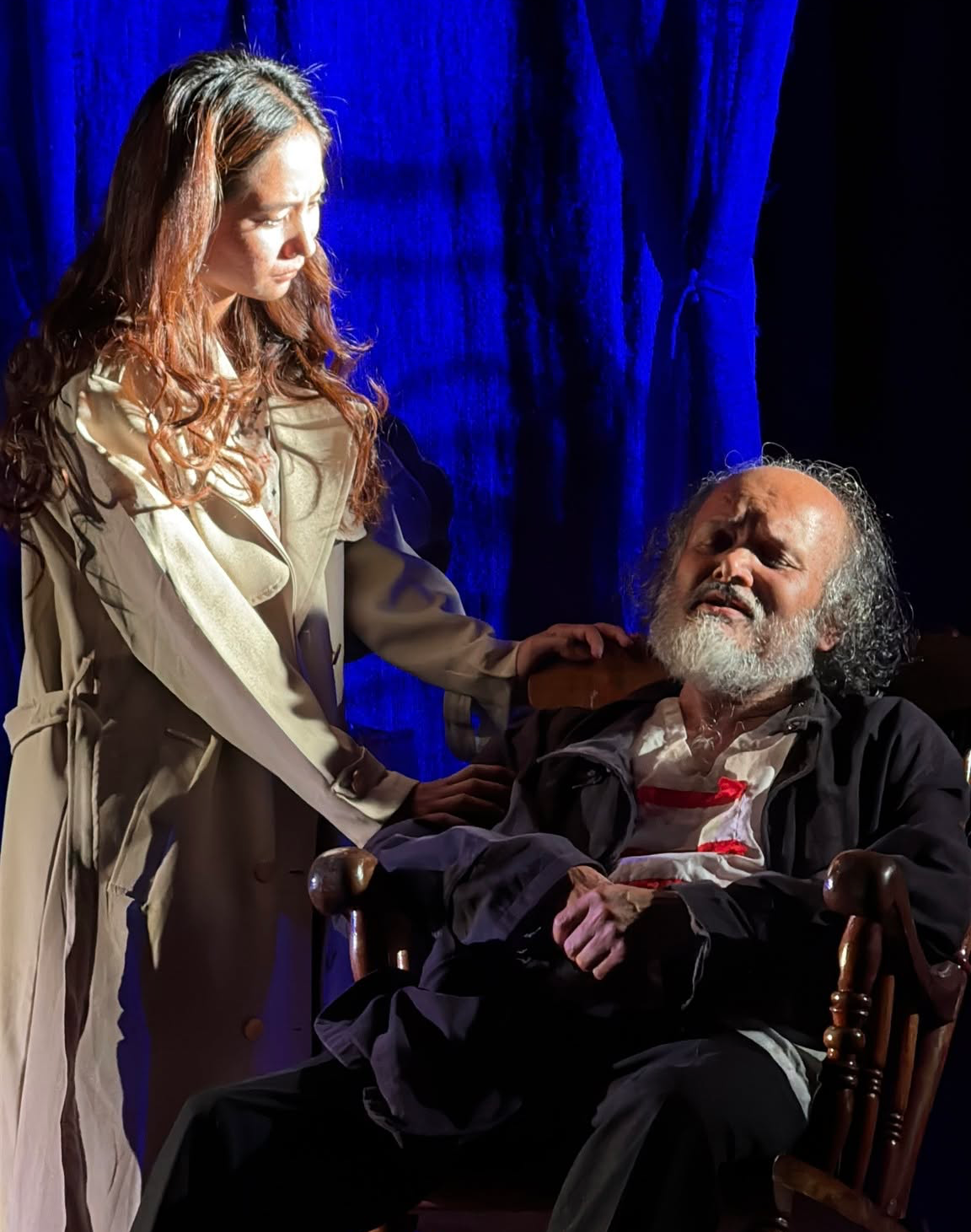
Photo credit: Shailee Theatre / Facebook
Within minutes, he moves through excitement, humour, embarrassment, nostalgia, fear, anger, self-pity and despair. Vasili emerges laughing, drunk and slightly ashamed of himself, convinced that he has just given the best performance of his life. He calls out for the theatre workers, but nobody answers. His own voice comes back to him. Slowly, the comedy begins to reveal loneliness. At sixty-eight, after forty-five years on stage, he suddenly sees the theatre after the lights have gone out. Beyond the footlights is darkness, and the familiar place that once gave him applause now feels almost frightening.
This is where Sunil Pokharel’s performance becomes extraordinary. He does not play old age as simply physical decline. He lets it appear through memory, hesitation, irritation, humour, sudden bursts of energy and the painful awareness of time. One moment he is almost childlike in his excitement; the next, he is confronting the years he cannot recover. His face, voice and body seem to carry different ages at once. That emotional range is what makes the opening so gripping.
There is also something deeply moving about watching Sunil Pokharel inhabit a character whose entire identity has been shaped by the stage. When Vasili speaks about the applause he once received, the garlands, the gifts, the audiences calling him back again and again, there is a strange tension between public recognition and private loneliness. The audience loved the performer, but who loved the man? When the performance ends, the applause disappears, and he is left asking what, if anything, remains of him.
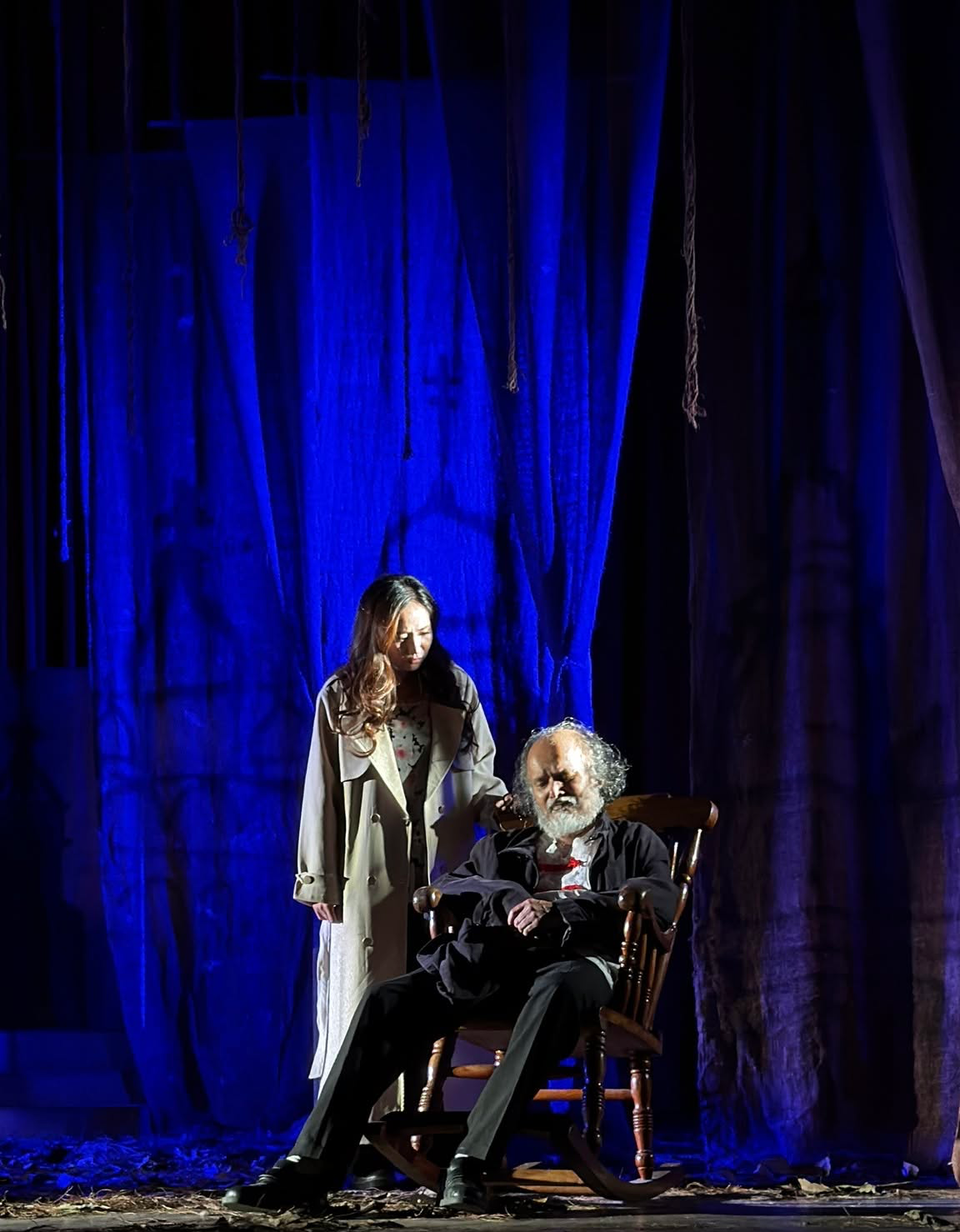
Photo credit: Shailee Theatre / Facebook
One of the play’s most powerful images is the nearly empty bottle: only a few drops remain at the bottom. The bottle becomes a life. Most of it has already been consumed; only the dregs are left. Vasili remembers the years he cannot relive, the woman he lost, the talent he believes he wasted, and the roles that gradually turned him into a clown rather than the serious artist he once imagined himself to be. He remembers being admired by audiences, yet nobody comes looking for him after the performance. Being admired is not the same as being loved. The audience goes home; the actor remains.
Sunil Pokharel handles this shift from vanity to vulnerability beautifully. There is no single emotional register to his Vasili. His self-pity can suddenly become funny; his humour can suddenly become painful. Even his fear of being alone carries traces of the performer who has spent a lifetime learning how to hold an audience. That contradiction makes him compelling: he is desperately seeking someone to listen, yet he is still performing even when there is almost no one left to perform for.
The memory of the woman who loved him after seeing him perform becomes another turning point. She admired the actor but would not marry him unless he left the stage. For Vasili, that rejection becomes a wound that reaches far beyond romance. It makes him question whether people ever loved him or simply loved what he could do in front of them. After losing her, he drifted into comic and buffoonish roles and eventually convinced himself that the serious artist he once was had disappeared.
And then Sunil Pokharel does something remarkable: he lets that artist return.
As Vasili begins recalling and performing the great dramatic passages from Shakespeare’s King Lear, Hamlet and Othello, Sunil Pokharel’s entire physical and vocal presence changes. His voice acquires a different authority. His rhythm becomes sharper. The body that seemed burdened by age suddenly remembers what it knows. It is not simply a man remembering his youth; it is an actor rediscovering the power of his craft.
That, perhaps, is the deepest pleasure of watching Sunil Pokharel in Antim Geet. The performance constantly reminds us that acting is not only about pretending to be someone else. Sometimes it is about finding something buried inside oneself and giving it form. When Vasili begins to perform again, the darkness around him seems to recede—not because his circumstances have magically changed, but because he has found the one language through which he still knows how to exist.
Nikita, played by Sabbu Gurung, becomes important in these moments because she listens, responds and eventually joins him in the performance. She gives Vasili someone with whom he can share that renewed artistic energy. But the emotional centre remains Sunil Pokharel. His Vasili is not simply an old actor looking back at a failed life; he is an artist discovering that the part of himself he thought he had lost is still there.
That is what makes Antim Geet resonate beyond Chekhov’s Russia. The questions it raises feel familiar to artists everywhere, including here in Nepal: What does art give you? What does it take from you? What happens when the applause stops? And what does it mean to discover that the part of yourself you thought was lost can still speak?
With Sunil Pokharel in the role, those questions carry an unusual weight. His long association with Nepali theatre creates a fascinating overlap between actor and character. We are watching Sunil Pokharel play a man looking back on decades of theatre, while knowing that the actor standing before us has his own deep history with the stage. The connection is never literal, but it is impossible not to feel it.
And perhaps that is also why Antim Geet feels so meaningful now. Watching a legendary actor like Sunil Pokharel command the stage with such force makes me wonder whether we give our great performers enough space in the limelight while they are still here to receive it. The irony is beautiful: he is playing a man afraid that his artistic life is disappearing, while on stage Sunil Pokharel demonstrates that there is still so much artistic life in him. Rather than making me mourn what might be fading, the performance makes me want to celebrate what is still burning.
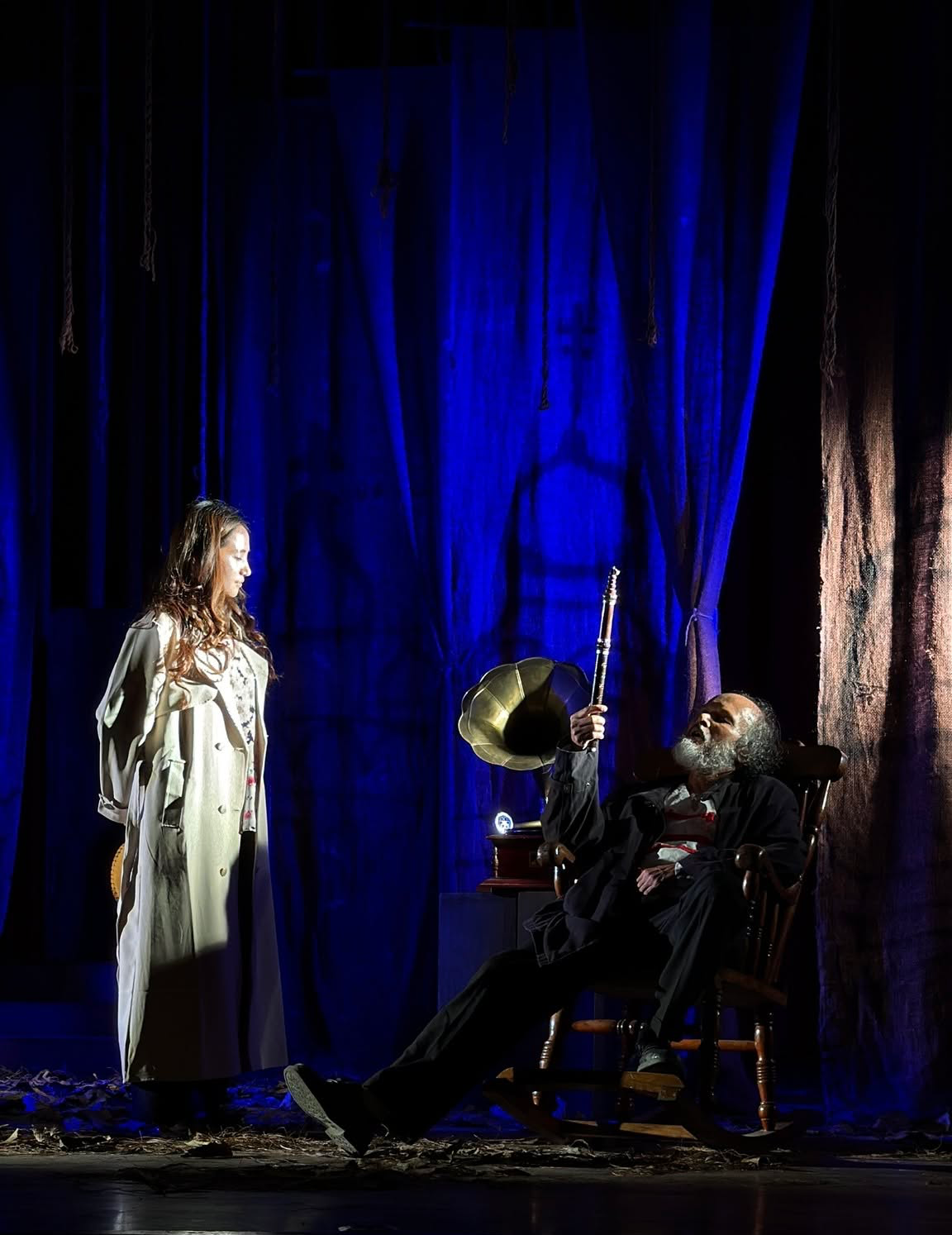
Photo credit: Shailee Theatre / Facebook
For me, Antim Geet is ultimately less about an ending than about rediscovery. Vasili may look back at a life filled with regret, but the stage gives him one more chance to remember who he is. And Sunil Pokharel turns that moment into something larger than nostalgia: a reminder that talent can outlive disappointment, that an artist can find his voice again, and that perhaps we should look more carefully at the legends standing before us while they are still creating.
Antim Geet reminds us that an artist’s life is not measured by applause alone, nor does it end when the lights begin to dim. As long as the voice remains, there is still something to say; as long as the stage remains, there is still something to reclaim. Sunil Pokharel makes that truth palpable. He does not merely play a man looking back on a life of theatre; he brings an artist back to life before our eyes. When the lights begin to dim across the stage, what lingers is not an ending, but the promise of renewal—a reminder that even when Antim Geet literally means ‘the last song,’ as long as there is a love for art, there is always hope, and hopefully, another song to be sung, another play to be performed, and another performance for us to witness.