
The quiet force of Ullozhukku: When grief becomes a flood
By Naran Malla, July 18
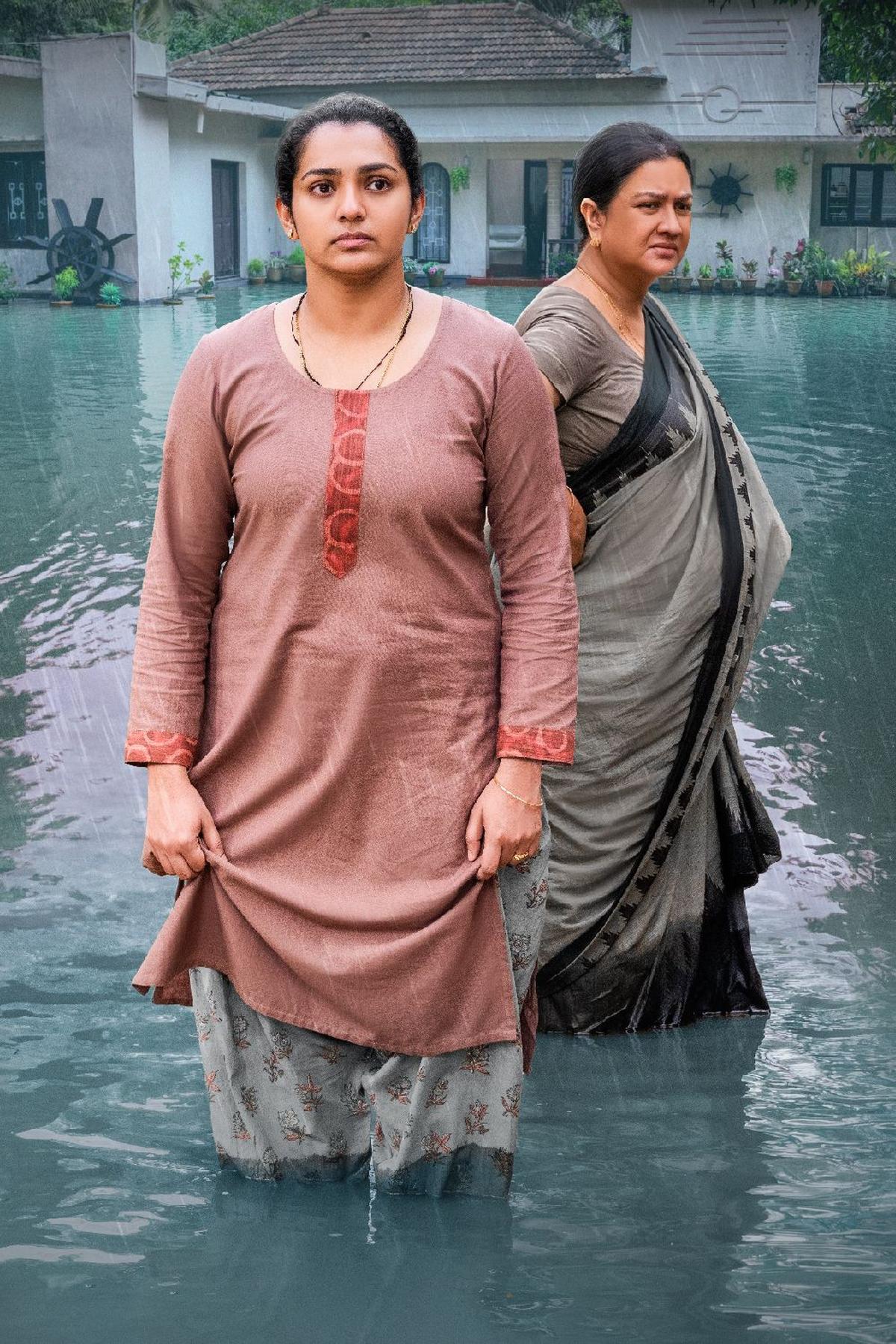
There is a moment in Christo Tomy’s Ullozhukku when the floodwaters become more than a natural disaster. They suspend time itself. A funeral cannot proceed because the roads have disappeared beneath water, forcing a family to remain together in a house that has become both sanctuary and prison. What begins as a logistical inconvenience slowly transforms into an emotional reckoning, as long-buried truths surface with the same inevitability as the rising river.
The metaphor is almost too neat, yet Ullozhukku never feels burdened by symbolism. Instead, it earns its emotional weight through remarkable restraint.
In a cinematic landscape increasingly dominated by high-concept narratives and exaggerated emotional beats, Tomy’s film finds its power in stillness—in conversations interrupted by silence, glances that linger a fraction too long, and grief that refuses to conform to familiar cinematic rhythms.
The story centres on Anju (Parvathy Thiruvothu), a young widow whose husband Thomaskutty dies unexpectedly. While the family prepares for the funeral, relentless flooding delays the burial, trapping everyone inside a home where private lives are no longer sustainable. Anju is pregnant, but the child is not her husband’s. Her relationship with her lover remains hidden beneath the rituals of mourning until circumstances begin to expose what everyone would rather leave unspoken.
This premise could easily have become an exercise in melodrama. Secret pregnancies, forbidden love and familial conflict are familiar ingredients of Indian cinema. Yet Ullozhukku resists sensationalism at every turn. Rather than asking who is right or wrong, the film asks a more unsettling question: what happens when social obligation and emotional truth become impossible to reconcile?That refusal to moralise is the film’s defining strength.
Anju is neither celebrated for defying convention nor punished for doing so. She is allowed to exist as a deeply contradictory human being—loving, frightened, selfish, compassionate and uncertain, sometimes within the same scene.
If Anju carries the film’s emotional conflict, Urvashi’s Leelamma embodies its moral complexity. A lesser film might have positioned the mother-in-law as an antagonist, the guardian of conservative values standing in the way of personal freedom. Tomy refuses such simplification. Leelamma’s possessiveness emerges not from cruelty but from accumulated loss, loneliness and a lifetime of measuring love through sacrifice. Urvashi delivers one of the year’s finest performances precisely because she never asks the audience for sympathy. She simply inhabits the contradictions of a woman who has spent so long caring for others that she no longer knows how to respond when life refuses to follow the script she has accepted.
Together, these performances elevate the film beyond domestic drama. What emerges is an exploration of two women negotiating the expectations placed upon them by family, religion and patriarchy. Their conflict is less personal than structural. Each has inherited a different understanding of duty, yet both remain constrained by systems that rarely permit women genuine agency. The film observes this reality with remarkable sensitivity, resisting both simplistic feminism and conservative moralism.

Tomy’s direction demonstrates an uncommon confidence for a debut feature. He trusts his audience to recognise emotional shifts without explanatory dialogue or manipulative background music. Scenes unfold with deliberate patience, allowing tension to accumulate naturally instead of being manufactured through editing or spectacle. This measured pacing occasionally tests the viewer’s patience, particularly during the middle act, but it ultimately serves the film’s emotional architecture. The silences are not empty; they are where the story truly unfolds.
The visual language complements this approach beautifully. Shehnad Jalal’s cinematography captures Kerala during the monsoon not as a picturesque landscape but as a living emotional environment. Rain is omnipresent, yet never merely atmospheric. Water becomes memory, confinement and revelation all at once. Every flooded road and submerged field mirrors the emotional state of the characters, suggesting that nature itself refuses to keep their secrets hidden.
Equally restrained is the film’s sound design. Instead of overwhelming emotional moments with orchestral cues, Ullozhukku allows ambient sounds—the rain, distant thunder and heavy silence within the house—to shape the viewing experience. This understated approach heightens rather than diminishes the emotional impact.
Perhaps the film’s greatest achievement lies in how it portrays grief. Indian cinema often presents mourning as a public performance, measured through tears and dramatic declarations. Here, grief is fragmented, contradictory and deeply private. Some characters cry openly; others become practical; still others retreat into silence. No single response is presented as more authentic than another. The film recognises that mourning is never simply about death. It is also about unfinished relationships, abandoned expectations and futures that quietly disappear.
This emotional honesty places Ullozhukku within the tradition of contemporary Malayalam cinema that prioritises psychological realism over narrative excess. Like the best films to emerge from the industry over the past decade, it trusts viewers to engage with ambiguity instead of resolving every conflict through neat conclusions. Even its ending refuses easy catharsis. There are moments of understanding, perhaps even forgiveness, but no miraculous reconciliation. Life continues, carrying its characters forward much like the floodwaters that reshape the landscape without asking permission.

If there is a limitation, it lies in the screenplay’s occasional reliance on metaphor. The flood, while undeniably effective, sometimes feels almost too carefully aligned with the emotional trajectory of the narrative. Yet this is a minor reservation in a film whose emotional intelligence consistently outweighs its symbolic ambitions.
Ullozhukku is ultimately a film about what remains submerged—desire beneath duty, compassion beneath resentment and truth beneath silence. It reminds us that families are often held together not by certainty but by fragile acts of accommodation, and that love rarely arrives in morally uncomplicated forms.
Long after the floodwaters recede, what lingers is not the revelation of secrets but the quiet recognition that every family carries its own undercurrents. Some simply remain hidden longer than others.